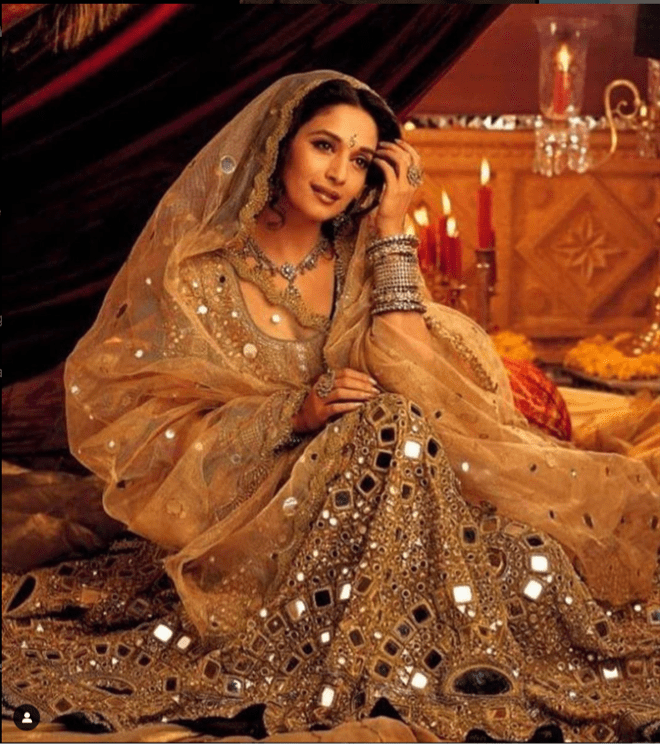
No, we’re not talking about that ghagra (but watch out for a future post!)
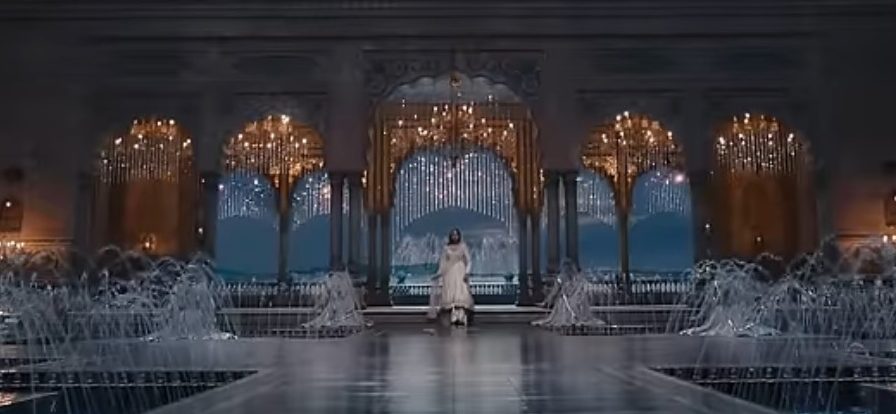
This image is arguably one of the best known from Sanjay Leela Bhansali’s 2002 magnum opus, Devdas. Based on the eponymous 1917 novel by Sarat Chandra Chattopadhyay, SLB’s big screen adaption took all of the visuals to the max – including the costumes.
We’ll get into the overall costume design in another post (or many posts given the number of costumes involved), but today I wanted to focus on this costume designed by Abu Jani and Sandeep Khosla which was never actually worn in the film! That’s right folks, despite being used heavily for promotional material, this image contains a costume which was never actually used in the film itself. For years, I wondered why given it would have been expensive to produce as well as being breathtakingly beautiful.
Before we get into why it wasn’t used in the film, let’s take a look at the costume itself.
Description/analysis
Initially, given we only had one shot of Dixit wearing the costume whilst sitting down, it was difficult to do a detailed analysis. However, in the years since the film’s release, we’ve had a few more images as well as the following description from Abu Sandeep’s official Instagram page:
“Seen in Devdas, this handcrafted ghagra features real mirrors embedded in the fabric with Zardozi embroidery. The flared, 10 panelled wonder took an entire team of highly skilled artisans two months to make and it weighs ten kilos as a set. 2015 saw the ghagra being featured at ‘The Fabric of India’ exhibit held at the Victoria & Albert Museum in London.
Abu Sandeep visualized Chandramukhi as Meera – a devotee of Lord Krishna. They saw her similarly devoted to Devdas and used colours, fabrics and accessories to express the subtleties of the enthralling but unfulfilled courtesan played by the legendary @madhuridixitnene.”
From what we can see, it appears that that the choli (blouse) and ghagra (skirt) are made from a gold toned fabric covered in a mixture of gold zardozi (embroidery using metallic wires couched down onto the fabric) and mirror work. It’s unclear what the fabric is, but I would guess it would have to be suitably substantial to be able to support the weight of the embroidery.
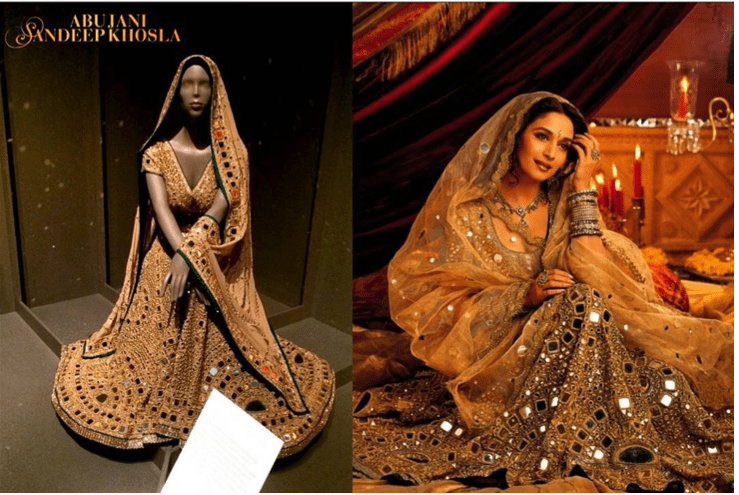
Fortunately for us, the costume (or at least versions of it) has also popped up in a few different places: after being used for the film, the costume was displayed at the Victoria & Albert Museum as part of the Fabrics of India exhibition in 2015. You can see from the image on the left that the while the ghagra (skirt) appears to be the same or very similar to the one worn by Dixit, the choli (blouse) or dupatta/odhni (veil) appear to be different. The choli worn by Dixit appears to have a scoop neck, whilst the one on display at the V&A has a v-neck.
Equally, Dixit’s veil appears to be made of a fine organza or tulle with mirrors in various sizes scattered all over, and with a scalloped (possibly crochet) edging all around the edges. The dupatta used in the display is made of a heavier fabric (perhaps a chiffon or georgette) and has a wide border and an overall design of concentric circles.
There’s a nice pop of colour with a green edging on the hem of the ghagra and piping on the neckline of the choli, with the V&A dupatta having a green edging and lining on the border.
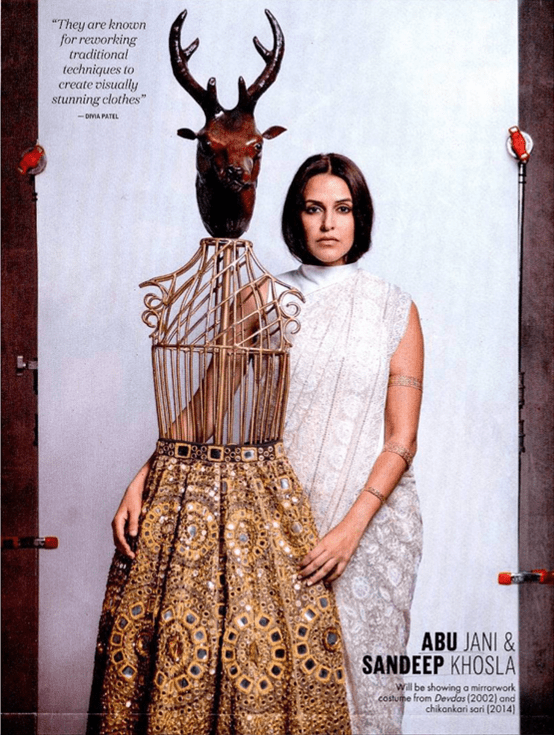
The above image of Neha Dhupia posing with the ghagra as part of the press around the V&A exhibition also gives us a glimpse of the waistband, which appears to be made of the same green fabric used for some of the other finishings with a combination of square and circular mirrors.
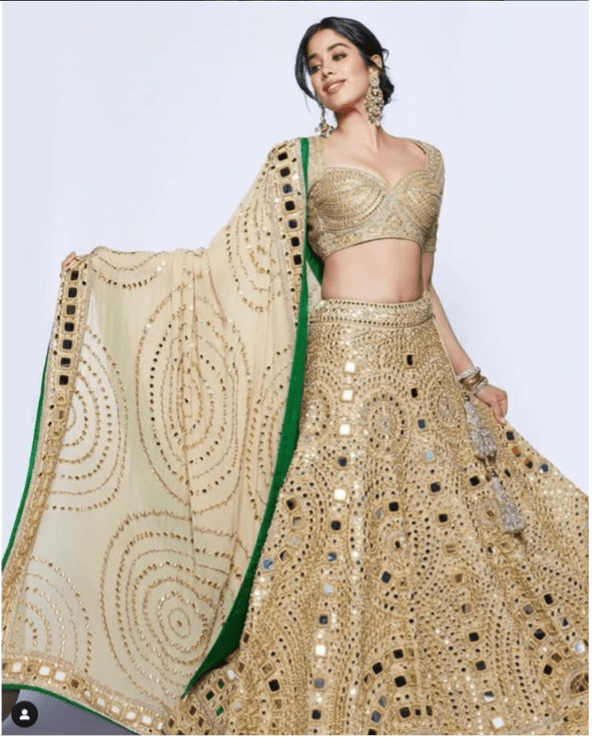
Actress Jhanvi Kapoor also wore a version of this costume for a wedding in 2021. Again, the ghagra appears to be similar to the original, but the waistband is different with a gold base and smaller mirrors than the version displayed at the V&A (and possibly the film version).
The blouse is clearly very different, but the dupatta appears to be the same as the version exhibited at the V&A.
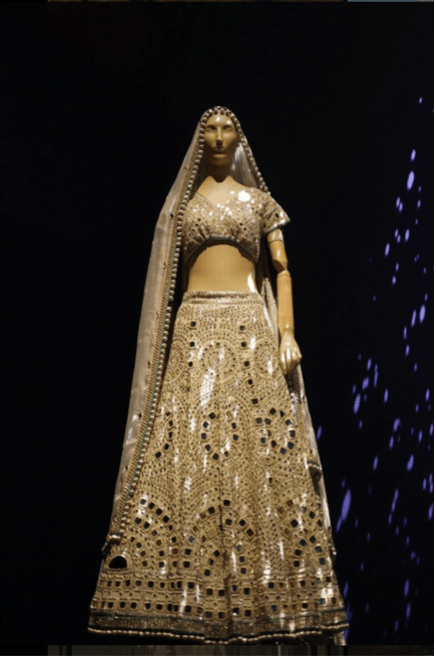
Most recently, another version of the costume has been on display at the Nita Mukesh Ambani Cultural Centre.
The ghagra appears to be the same as the version worn by Jhanvi Kapoor, however with little gold balls added to the hem. The choli appears to be the same as the V&A version, however the dupatta is different to the previous versions; it appears to be made of organza (like the original), but with a straight edged border and the same golden balls as on the hem of the ghagra (and a nice nod to Dixit’s costume from the song Kahe Ched Mohe from Devdas).
The description from the NMACC website reads:
“The Devdas mirror ghagra (2001)
Jani and Khosla created their first couture mirror ensemble in 1989. Twelve years later, came this gharara hand-embroidered with real mirrors and zardozi work, which was worn by Madhuri Dixit-Nene in Sanjay Leela Bhansali’s onscreen saga Devdas. A movie for which the duo received the National Award for Costume Design as well. The flared 10-kilo, 10-panel ghagra took a team of 50 highly- skilled artisans two months to make, becoming the most talked-about piece from the repertoire created for the film. Ironically it didn’t eventually feature in the movie but was part of the ‘The Fabric of India’ exhibit at the Victoria & Albert Museum, London, in 2015. “Embroideries from Gujarat have always fascinated us—we work on both thread and mirrorwork techniques from the state. We love reinventing traditional mirrorwork, which is quintessentially folksy, transforming it into fabulous couture,” they say.”
So why was the costume never used in the film?
The real turning point in understanding the origin of this costume came when I listened to All About Movies with Anupama Chopra where she had Abu and Sandeep on as guests in May 2023. You can listen to them talking about the costume at around the 15:27 mark. They say:
“...at that time the song was a different song, it was going to be a Birju Maharaj song… When we first heard it, there were two songs by Birju Maharaj in the film. The first one was of course the iconic Kahe Ched Ched [Kahe Ched Mohe], and the other one Maar Dala came about, it changed narrative with Saroj Khan later. The whole idea was that she’s waiting for him to come. So we said instead of these hundred diyas being lit, and she’s waiting, it should be these hundred diyas are coming from her skirt… the reflections of the diyas in the skirt just spread wide on the ground… and then she would have that lovely vision of it. Unfortunately the song only changed… it had to have that… Muslim kind of touch… so she [Saroj Khan] said make the costume lighter, let’s make the costume more transparent and she changed the whole look of it, it became slightly more commercial…“
So there you have it! The costume changed because it was intended for a song that ended up getting replaced by Saroj Khan, the choreographer of the now legendary Maar Dala which required a different look.
It’s interesting that the description by Abu Sandeep notes the ghagra as having 10 panels. Given what we know now about this being intended to be used for a kathak song, I would have thought they would have wanted to achieve a similar flare to that of the ghagra worn by Dixit in the song Kahe Ched Mohe (which was a full circle skirt). 10 panels wouldn’t be enough to achieve the same kind of flare, but perhaps this was done to help limit the weight Dixit would have had to carry while dancing.
So racking up a total of two cholis, two/three ghagras, and three dupattas the costume has been through the quite the journey! Which version is your favourite? Tell us in the comments.
 The Costume Review
Leave a comment